The 3 Biggest Questions UK Triathletes Are Asking Right Now

Triathlon has never been more accessible.
There are more races, training platforms, smart trainers, watches and online resources than ever before.
Yet there is a problem.
There is also more information than most triathletes know what to do with.
Scroll through triathlon forums, Facebook groups and online communities and you'll see the same questions appearing again and again:
How much should I actually be training?
Why isn't my swim getting any faster?
What should I eat and drink during a 70.3?
Am I training too much?
Do I need a coach?
Should I be doing more Zone 2?
Why do I feel great on the bike but struggle on the run?
How do I fit triathlon around work and family?
For UK age-group triathletes, particularly those targeting 70.3 and Ironman events, the challenge isn't usually a lack of motivation.
It's knowing what matters most.
Here are three of the biggest questions athletes are asking — and what you should be thinking about instead.
1. "How much training do I actually need?"
This is probably the biggest question of all.
And the answer isn't simply:
More.
A common mistake is to look at what other triathletes are doing and assume you need to replicate their training volume.
One athlete is swimming four times a week.
Another is cycling 250km.
Someone else is running 50km.
Then there's the person on Strava who appears to have spent half their life training.
But your training needs to fit your life, your current fitness, your experience and your race goal.
A well-designed training week might include:
2–3 swims
2–4 bike sessions
2–4 runs
strength or mobility
recovery
But that doesn't mean every session needs to be hard.
In fact, one of the biggest improvements many age-group athletes can make is learning how to distinguish between training that creates adaptation and training that simply creates fatigue.
Training for the athlete you actually are
If you work full-time, have a family and other commitments, your training needs to be sustainable.
That might mean five or six carefully chosen sessions rather than trying to squeeze 12 sessions into your week.
The question shouldn't be:
"How many hours can I train?"
It should be:
"What gives me the biggest return for the time I have available?"
This becomes particularly important as you move towards 70.3 and Ironman distance.
Longer isn't automatically better.
Specific, progressive and consistent beats heroic.
2. "Why isn't my swimming getting any faster?"
Swimming is a huge frustration for many triathletes.
You can spend months swimming twice or three times a week and still feel as though you're going nowhere.
The natural reaction is often to swim more.
But if the problem is primarily technical, adding more volume can simply mean practising the same inefficiencies for longer.
Current triathlon discussions repeatedly highlight swimming as a weakness for newer athletes, particularly those coming from running or cycling backgrounds.
Fitness isn't always the problem
Consider two swimmers.
Swimmer A
Can swim 2,000m but:
crosses over with the hands
drops the elbow
over-kicks
has poor body position
lifts the head to breathe
Swimmer B
Has a more efficient stroke and maintains a better body position.
Swimmer B may be considerably faster despite having less swimming fitness.
That's why simply adding another 2km to your week isn't necessarily the answer.
You first need to identify where you're losing speed.
The triathlon swim is different
And there's another consideration.
Your goal isn't necessarily to become a pool swimmer.
It's to become a better triathlon swimmer.
That means developing:
efficient front crawl
bilateral and adaptable breathing
sighting
swimming straight
drafting
pacing
confidence in open water
swimming around other athletes
adapting to chop and currents
maintaining technique when fatigued
Open-water confidence is particularly important in the UK, where water temperature and race conditions can add another layer of uncertainty. Recent UK triathlon coverage has focused specifically on preparing for non-wetsuit swims and the anxiety surrounding changing water conditions.
So instead of asking:
"How can I swim more?"
ask:
"What is limiting my swim performance?"
That is a much better question.
3. "What should I eat and drink during a 70.3?"
This is becoming an increasingly important topic as more athletes move towards longer-distance racing.
And it's easy to see why.
A 70.3 is long enough that nutrition can have a major impact on performance.
You can have an excellent training plan, strong bike fitness and a good run — and still have a terrible race because you got your fuelling wrong.
Recent triathlete discussions include athletes experimenting with carbohydrate intake, gels and different strategies after experiencing stomach problems during racing.
The biggest mistake?
Leaving nutrition until race day.
Your race nutrition should be trained just like your swimming, cycling and running.
That means experimenting with:
carbohydrate quantity
carbohydrate sources
drink concentration
gels
solid food where appropriate
fluid intake
sodium/electrolytes
timing
caffeine
And, importantly, testing everything during long training sessions.
Because there's a huge difference between:
"This nutrition product works for me."
and
"This nutrition strategy works for me after three hours of cycling followed by a run."
The second is what matters.
Your nutrition needs to match your race
A flat, fast 70.3 isn't necessarily fuelled in exactly the same way as a hilly course.
Your expected bike duration, intensity, weather, heat, aid-station availability and individual tolerance all matter.
That's why copying someone else's nutrition plan from Instagram isn't necessarily a good idea.
Your strategy should be individualised and rehearsed.
The bigger picture
Interestingly, these three questions are connected.
Your training determines your fitness.
Your swimming technique determines how efficiently you get through the first discipline.
Your nutrition determines whether you can actually express your fitness over the whole race.
And underneath all three is the same principle:
Stop doing more. Start doing what matters.
Triathlon information isn't difficult to find anymore.
The difficult part is working out which information applies to you.
A 30-year-old former competitive swimmer training 15 hours a week for an Olympic-distance race doesn't need the same approach as a 48-year-old first-time 70.3 athlete with a full-time job and six hours a week available.
Your training should reflect:
Your goal.Your current ability.Your available time.Your strengths and weaknesses.And the demands of your race.
That's where coaching becomes valuable.
Not simply giving you more sessions.
But helping you understand why you're doing each session — and what you should be getting from it.
The question isn't "How much can I train?"
It's:
"What is the smartest way for me to train?"
And for many UK age-group triathletes, that's the question that will make the biggest difference to their next race.
Ready to stop guessing and start training with purpose?
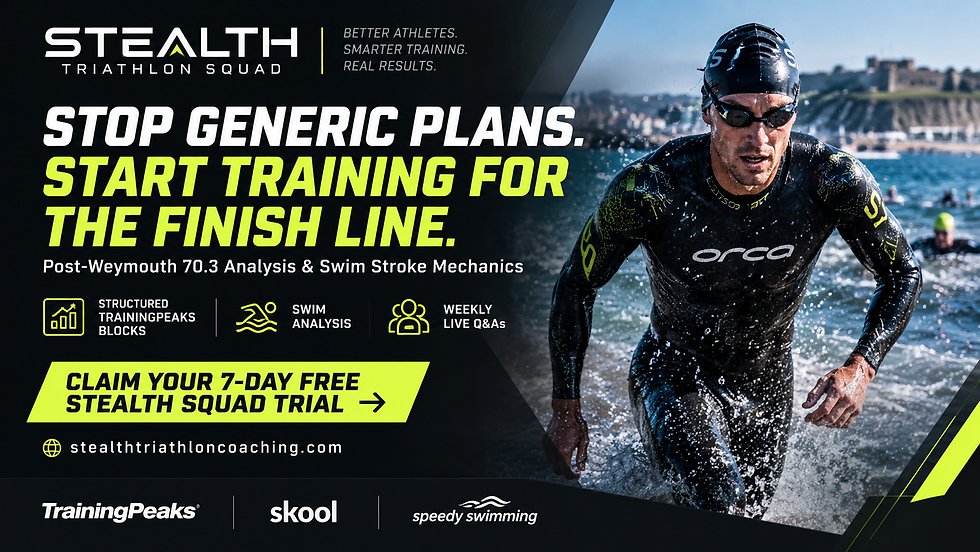
If you're training for a 70.3, T100 or Ironman and want more from your training than simply ticking off sessions, the Stealth Triathlon Squad is built for you.
Inside Stealth, you get:
Personalised training through Vekta — your sessions, training data and performance trends brought together in one place.
Expert coaching and guidance — understand what your training is actually doing and what to focus on next.
A squad around you — connect with other ambitious age-group triathletes, ask questions, share progress and stay accountable.
Weekly Stealth Briefings — practical strategies covering swimming, cycling, running, fuelling, recovery and race preparation.
A smarter approach to 70.3, T100 and Ironman training — less guesswork, fewer junk miles and more training that has a purpose.
Train smarter. Race faster. Stay consistent.
Join the Stealth Triathlon Squad and start building your next season with a plan.









Comments